

Every day, tens of thousands of passengers travel through modern airports towards their final destination. Effective passenger flow is crucial to reducing operational costs, increasing passenger satisfaction, and ensuring the on-time performance that top airlines demand. With passenger numbers increasing steadily, airports around the world are facing the growing challenge of understanding and managing passenger flows.
In this article, we'll cover what airport passenger flow is, why effective passenger flow is important, and how to manage it in the modern airport.
What is passenger flow?
Effective passenger flow management makes the difference between a chaotic terminal and an efficient, stress-free passenger journey from check-in to departure and arrival at the final destination.
Managing this movement requires a balance of clear physical layouts and digital touchpoints. For example, clear signage with universally recognizable icons helps improve passenger navigation throughout airport pathways, while digital ticketing enables contactless gate entry to speed up security and lounge access.
Every process that passengers navigate through poses a potential bottleneck. Airports must carefully orchestrate passenger flows across various checkpoints and areas, including:
- Check-in
- Security screening
- Immigration and customs for international / intercontinental flights
- Boarding gates and associated waiting areas
- Disembarking and baggage claim
- Transit and transfer areas for passengers changing flights
- Commercial and public spaces, such as retail shops, restaurants, and lounges
Why effective passenger flow management matters
Airport passenger flow optimization is critical to streamlining operations, reducing wait times, and enhancing overall passenger satisfaction.
When airports prioritize this they gain the operational agility needed for precise resource allocation during peak travel windows. This level of operational efficiency is a direct catalyst for revenue generation: Smooth passenger traffic directly impacts customer satisfaction and gives travelers more time and a better mindset to utilize airport amenities.
How to manage passenger flows in your airport
Smart queue management with real-time analytics
In today’s airports, smart queue management is essential for a smooth passenger flow. Driven by this reality, the airport industry is rapidly transitioning away from reactive planning toward real-time data analytics.
Historically, managing these high-traffic areas meant reacting to lines as they formed. Now, airports are eliminating that friction by implementing dynamic resource allocation strategies. Leveraging real-time information to manage passenger flow with precise data ensures checkpoint operations run efficiently. As a result, operators can actively shorten queue lengths, optimize operations, and reduce wait times on the fly.
The role of data collection and predictive analytics
Efficient passenger flow management starts with smart data collection. By deploying real-time monitoring systems using sensors and cameras, modern airports can track passenger movements through various checkpoints, helping to identify bottlenecks and reduce congestion before it spreads. Today, advanced LiDAR technology is increasingly being utilized to enhance operational efficiency and customer satisfaction by providing highly accurate, privacy-compliant tracking of these crowd dynamics.
Once gathered, this data serves a greater purpose than simple real-time tracking. By combining live inputs with historical data, airports can leverage machine learning, AI, and predictive analytics. Predictive analytics play a crucial role in forecasting airport passenger flow, allowing operations teams to anticipate peak travel times, allocate staff accurately, and proactively reduce wait times to enhance the overall travel experience.
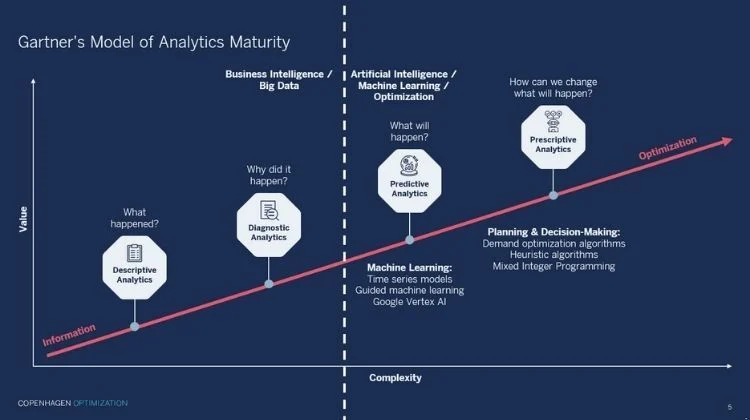 When airports operate with outdated tools or static planning models, they often get stuck at the lower end of Gartner’s Analytics Maturity Model. With predictive analytics, airports can forecast passenger surges, baggage demand, or gate usage with remarkable accuracy to efficiently manage flow.
Unifying airport operations with a passenger flow management platform
For operators to get the most value out of their data, the core operations of a modern airport can no longer be conducted in silos. Implementing smart, integrated passenger flow management strategies creates a more seamless travel environment that benefits passengers, airlines, and airport employees alike.
This is why Copenhagen Optimization has developed Better Airport: a cloud-based airport management SaaS platform that gives all airports, regardless of size, a simpler way to run core operations.
Featuring nine core modules for airport optimization, Better Airport allows airports to mix and match modules to create a solution perfectly suited to the specific needs of the individual airport. Every module can be connected, making it easy to forecast, understand, and plan passenger and baggage flows throughout the airport. We call this way of working Connected Operations, and we believe it's the future of airport technology.
What can a passenger flow management platform solve?
Plan for the future with Better Forecast
Without accurate, cross-departmental forecasts, maintaining a smooth passenger flow and high operational efficiency is nearly impossible. To manage passenger flow effectively, your operations teams need the full picture for critical decision-making.
That is why we developed Better Forecast. The solution provides passenger and baggage presentation profiles for all areas of the airport, creating a solid foundation for optimized airport operations. Utilizing machine learning and automation, Better Forecast eliminates manual processes to improve operational efficiency.
The solution helps you:
- Plan ahead and react on time: With accurate flight-by-flight forecasts and real-time updates every few minutes, Better Forecast enables you to react in the present, as well as make informed decisions for the future.
- Optimize resource allocation: When flight arrival times change, Better Forecast updates accordingly, enabling you to allocate staff and resources accurately and reduce wait times.
- Improve the passenger experience: Eliminating resource bottlenecks keeps your passenger flow moving dynamically, giving travelers a smoother, stress-free journey through the airport.
Optimize baggage flows with Better Baggage
When it comes to managing airport passenger flow, baggage reclaim is a critical zone. Because this area is uniquely prone to crowding and congestion, delays at the carousels can quickly ripple across the terminal, causing travelers to miss connecting flights or ground transportation.
To keep baggage flows balanced and baggage handling systems running smoothly, we have developed Better Baggage: a cloud-based management platform designed to keep your infrastructure operating at full capacity. By analyzing every luggage stream, the system pinpoints exactly where bottlenecks form before they can disrupt airport operations.
The solution helps you:
- Make data-driven decisions: Better Baggage enables you to clearly understand your future needs while ensuring optimal day-to-day operations.
- Streamline reclaim: By analyzing baggage load and passenger arrival curves, Better Baggage streamlines the reclaim experience and optimizes the flow of your baggage handling.
- Optimize outbound infrastructure: With accurate daily forecasting of incoming bag numbers, Better Baggage enables your airport to optimize its make-up positions (MUP), early bag storage (EBS) set-up, and baggage handling flows.
Optimize airport passenger flow with Copenhagen Optimization
Efficient passenger flow is crucial to minimizing wait times, reducing congestion, and ensuring smooth airport operations. This makes managing passenger flow a central aspect of maintaining operational efficiency in the modern airport.
Imagine an airport where passengers are not held up in long lines or flow bottlenecks; an airport where the passenger experience centers around excitement for the journey ahead. At Copenhagen Optimization, we want to help you achieve just that.
Frequently asked questions
What is a passenger flow management platform?
Think of a passenger flow management platform as the central nervous system for modern airport operations. Instead of allowing vital checkpoints to run in isolated silos, this software unifies live data from sensors, cameras, and flight schedules across the entire transportation system. It provides a single, connected dashboard to map passenger movement across all airport touchpoints, allowing teams to effectively manage passenger flow, identify bottlenecks, and make informed decisions based on precise data.
How does the platform reduce passenger waiting time?
It eliminates reactive staffing by introducing predictive analytics to completely optimize resource allocation. When the platform flags a projected bottleneck at security checkpoints or check-in areas, managers can dynamically allocate staff and deploy security personnel before the crowds build. This proactive approach directly shrinks queue lengths, improves overall efficiency, and reduces passenger waiting time during peak travel windows.
How do CUPPS and CUSS integrate with passenger flow software?
They act as your front-line data collection assets. CUSS (Common Use Self-Service) kiosks capture early check-in metrics, while CUPPS (Common Use Passenger Processing Systems) track gate and counter velocity. Feeding the data directly into a central passenger flow management platform allows the system to cross-reference live feeds with historical data. This delivers detailed insights into terminal processing speeds, making it much easier to streamline security processes and improve the travel experience.
How does technology help airports meet passenger wait-time targets?
In air travel, passengers often arrive up to 3 hours early for international departures and expect to clear security checkpoints in under 30 minutes. A modern passenger flow management platform ensures the airport hits its side of this operational service level agreement (SLA). By monitoring real-time updates and keeping processing times under control, this technology helps guide passengers smoothly into the departure concourse, optimizing their overall journey and leaving them with more time to spend at retail and dining facilities.


-1.png?width=1080&height=1080&name=Design%20uden%20navn%20(19)-1.png)