September 14, 2026

Modern airports are among the most system-dense operations on earth. A single large airport can run dozens of separate information systems at once. For decades these airport systems were deployed in isolation, each solving its own problem. Airport IT is the layer that ties them together, so the airport runs on one shared picture instead of dozens of disconnected ones.
This guide explains what these solutions are, the core systems that keep airports running, how the airport industry is moving from siloed systems to integrated, cloud-based operations, and what that shift means for airport operations, passengers, and the airlines and partners an airport serves.
Airport IT solutions are the information technology systems, software, and services that plan, run, and connect airport operations. They cover passenger processing, baggage, ground handling, airport security, and the data management layer that ties them together. The best airport solutions do not just digitize one process. They make the many systems an airport already runs behave like one, giving airport management a single real-time view and tighter control across the terminal and the airfield.
For the airport industry, information technology has become core infrastructure. Effective IT solutions for airports focus on three things: digitalization, automation, and analytics. Get those right, and airports improve operational efficiency, cut costs, and serve more passengers with better services, using resources and facilities they already have.
The hard part is not any single system, it is the number of them. Airports use dozens of separate information systems for daily operations, and historically each ran on its own server, with its own records, maintained by its own team. That fragmentation across airport operations is where delays, cost, and risk creep in, from the terminal and airfield to landside operations.
Here are the key systems every airport relies on:
The airport operational database, or AODB, is the backbone. It centralizes data for daily flights, aircraft movements, and resource allocation, and it is the single source other airport systems draw on. A strong AODB is the difference between systems that talk to each other and systems that do not.
Flight information display systems are the passenger-facing layer, the screens that show flight operations status across the terminal. Behind the screens, the same information drives boarding gates, the check-in process, and air traffic control coordination, so accuracy matters far beyond the display.
Passenger processing covers everything from staffed check-in counters to check-in kiosks and self-service solutions on passengers' own mobile devices. Self-service has become the default, and airports keep expanding these services because they speed up check-in and free staff for higher-value work. Better passenger processing is one of the clearest ways airport IT improves the passenger experience.
Baggage is where IT pays off fastest. Automated baggage management can cut mishandling dramatically, and integrated baggage systems keep bags moving with the passengers who own them. Given how much a single mishandled bag costs in credibility and man hours, the maintenance and reliability of these baggage systems is business critical.
Ground handling services, from aircraft turnarounds to the crews and equipment around each aircraft, sit at the center of on-time performance. When that information reaches the same systems as everything else, airports allocate stands, staff, and equipment against real demand instead of a static plan, and airlines see fewer delays.
An airport is critical national infrastructure, and the more its systems connect, the wider the attack surface. When a departure control or baggage system fails, check-in stops and aircraft sit idle. That is why airport safety and security now depend as much on protecting systems as on physical screening. Connected IT systems streamline airport operations and sharpen security, so cybersecurity is now core to running an airport.
The direction of travel for the airport industry is clear: from dozens of siloed systems to integrated, cloud-based airport solutions that share information across airport operations in real time. We call that Connected Operations, and it’s what we’ve built Better Airport to deliver. When systems work from one source of truth, airport operations run more efficiently, airlines recover from disruption faster, and airports stop paying to maintain duplicate tools and point solutions.

Cloud-based solutions provide the flexibility and agility that on-premise systems cannot. Most airports now run at least part of their operations on cloud-based solutions, and cloud technology enables real-time data sharing among airport systems, which makes coordinated operations possible. Cloud solutions also improve resource allocation for faster aircraft turnarounds.
Done right, data integration improves decision-making across airport operations, and advanced analytics turn that integrated information into foresight. Done poorly, it just moves the silos around. Airport management software optimizes passenger processing and baggage handling, and software solutions improve operational efficiency and reduce costs. The airports pulling ahead pair strong data management with advanced analytics to move from reacting to predicting.
Airport Collaborative Decision Making, or A-CDM, is the framework that gets airlines, ground handling, air traffic control, and airport management working from the same numbers, so airlines and the airport stop planning in separate silos. A-CDM is not only an efficiency play. It also cuts fuel burn and emissions on every departure, so the same integration that improves operational efficiency supports an airport's sustainability goals too.
A handful of technologies are reshaping airports right now, and each one builds on connected systems and shared data. Artificial intelligence reads the operation live, spotting security checkpoint congestion and recalculating gate allocation across airport operations as conditions change. Digital twins go further, running a live virtual model of the airport so teams can test a change before committing in the real terminal. Automation, analytics, cloud, and connected solutions build on the same base, and the success stories airports talk about almost always start with integration.
This technology earns its keep in one place: fewer delays, greater efficiency, and a better passenger experience. When systems share information, airports process passengers faster, keep services moving, and recover before disruption snowballs. For airport management, integrated airport solutions improve operational efficiency and reduce costs at once.
Better operations also open new revenue. Understanding passenger flow in real time lets airports grow non-aeronautical revenue from retail, parking, and premium services.
Legacy software, tight budgets, and the cost of maintaining dozens of platforms all slow airports down. The solutions that work share a pattern: consolidate systems and services, move to the cloud, treat integration as a program, and keep costs under control. Even back-office functions such as application management and billing are folding into the same platform, instead of running as separate silos.
Looking to the future, the airport management teams investing in integration and analytics capabilities will cope with rising traffic, not rising headcount. Future-ready strategies deploy AI and automation on top of that connected base, and the capabilities an airport builds today shape the challenges it handles tomorrow.
No airport does this alone, so for airport management, the technology partners matter as much as the information technology itself. The best partners pair deep expertise with a track record of implementation and the support and services that last well beyond go-live. What sets good partners apart is rarely features or company size. It is communication, and whether their solutions have been deployed at airports like yours, with the strategies and success stories to match. Strong partners also build their customers' internal capabilities and keep communication open, so customers are not left leaning on outside support for every change.
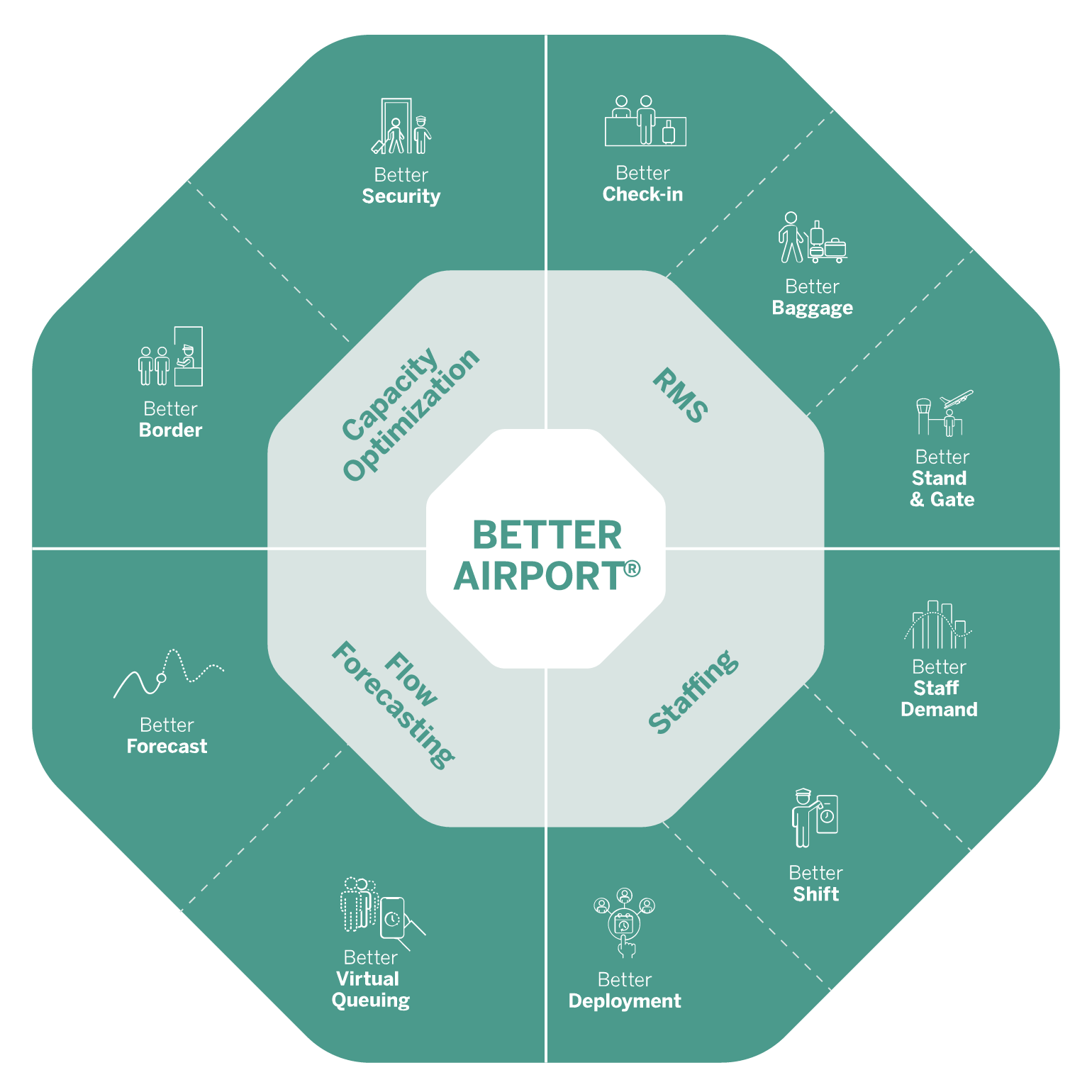
Most airports do not need more systems. They need the systems they already have to work as one. That is the focus of our work at Copenhagen Optimization. We are a company built by airport people, and our Better Airport platform and related solutions connect forecasting, resource allocation, and real-time operations across the systems airports already run.
Our customers range from regional airports to some of the world's busiest airports. We combine deep aviation expertise with the implementation, support, and services that turn a deployment into results. Every customer we serve gets the same hands-on support from a team that knows airports, backed by long-term support, services, and the same focus on operational efficiency. That is the kind of partner our customers build a future on.
If you want to see how connected airport IT could improve operational efficiency at your airport, book a demo with our team.
The most talked-about are biometrics, AI, digital twins, and autonomous robots. Biometrics enable seamless single-token travel, letting passengers move through the airport on their face alone, which is why more airports are rolling out biometric ID management. AI analyzes security checkpoint congestion and boarding progress and recalculates variables to optimize gate allocation, while digital twins model a whole terminal, and cloud platforms and connected solutions tie it together. All of it builds on integrated systems and data, so airport operations shift from reactive to predictive.
An airport IT technician keeps the systems and operations that run an airport working, from check-in kiosks and baggage systems to networks and information systems. Increasingly the role is about integration and analytics, not just fixing hardware.
Increasingly the answer is cloud, or a hybrid. Cloud-based systems scale more easily, cost less to run, and share information in real time. Many keep safety-critical systems on-premise and move the rest to the cloud, without giving up control.